Collector Guide16 min read

Cooper Flagg's 1/1 Debut Patch Auto Was Pulled. Why It Could Sell for $3 Million-$4 Million

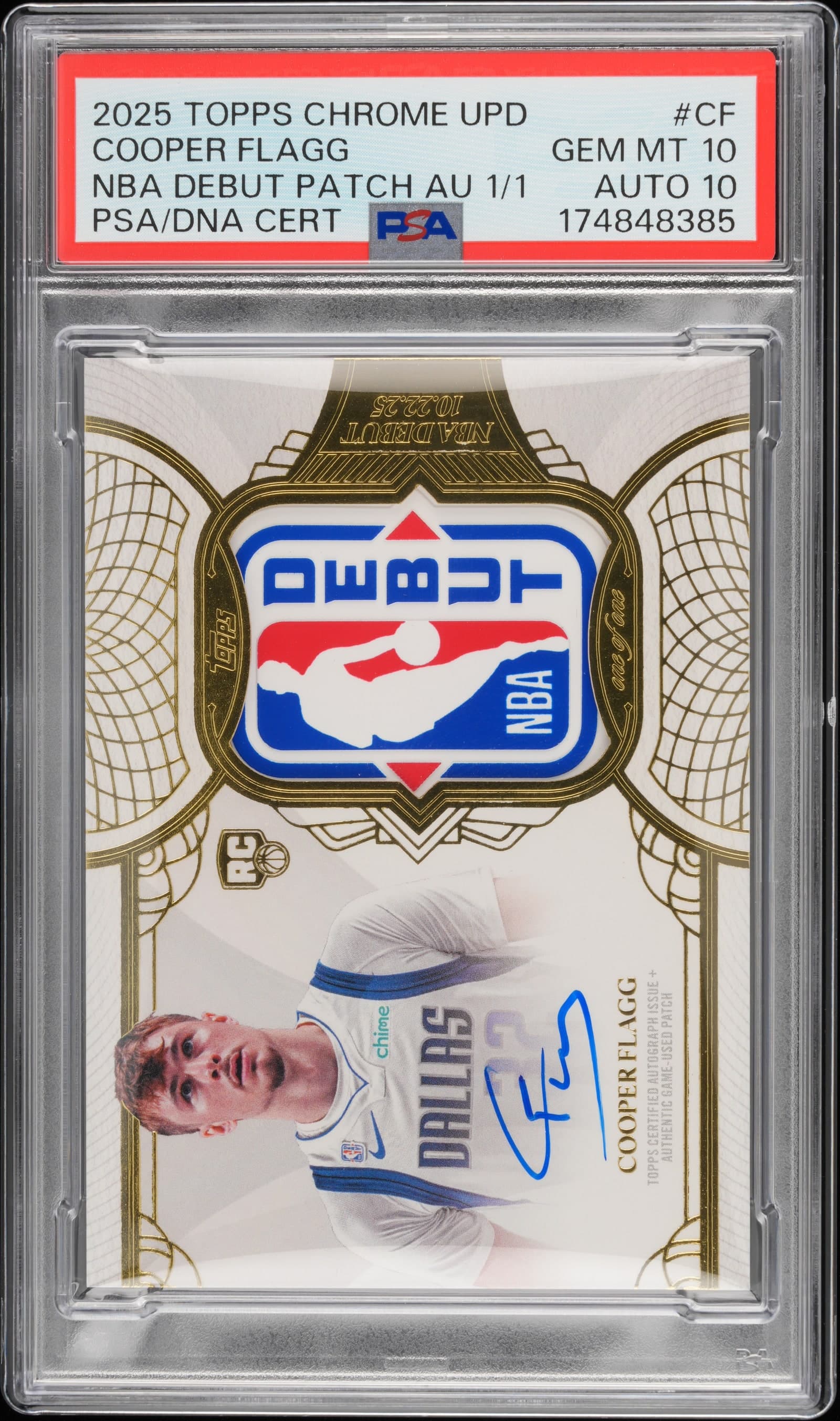
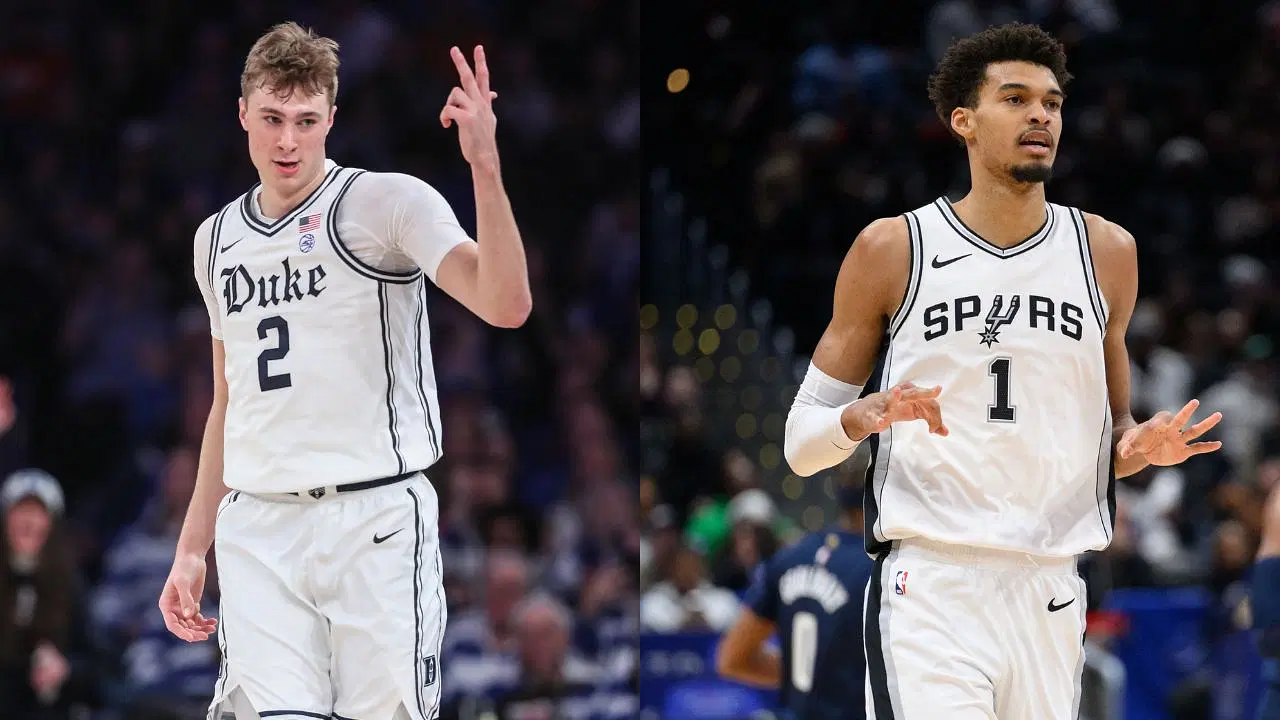
Cooper Flagg's NBA Debut Patch Auto is out of packs. The autographed one-of-one features the game-worn patch from his first NBA game. It also headlines the first Rookie Debut Patch class in NBA history. The card could sell for $3 million to $4 million. Here's what the strongest comparable sales tell us.

By Brady

Last updated

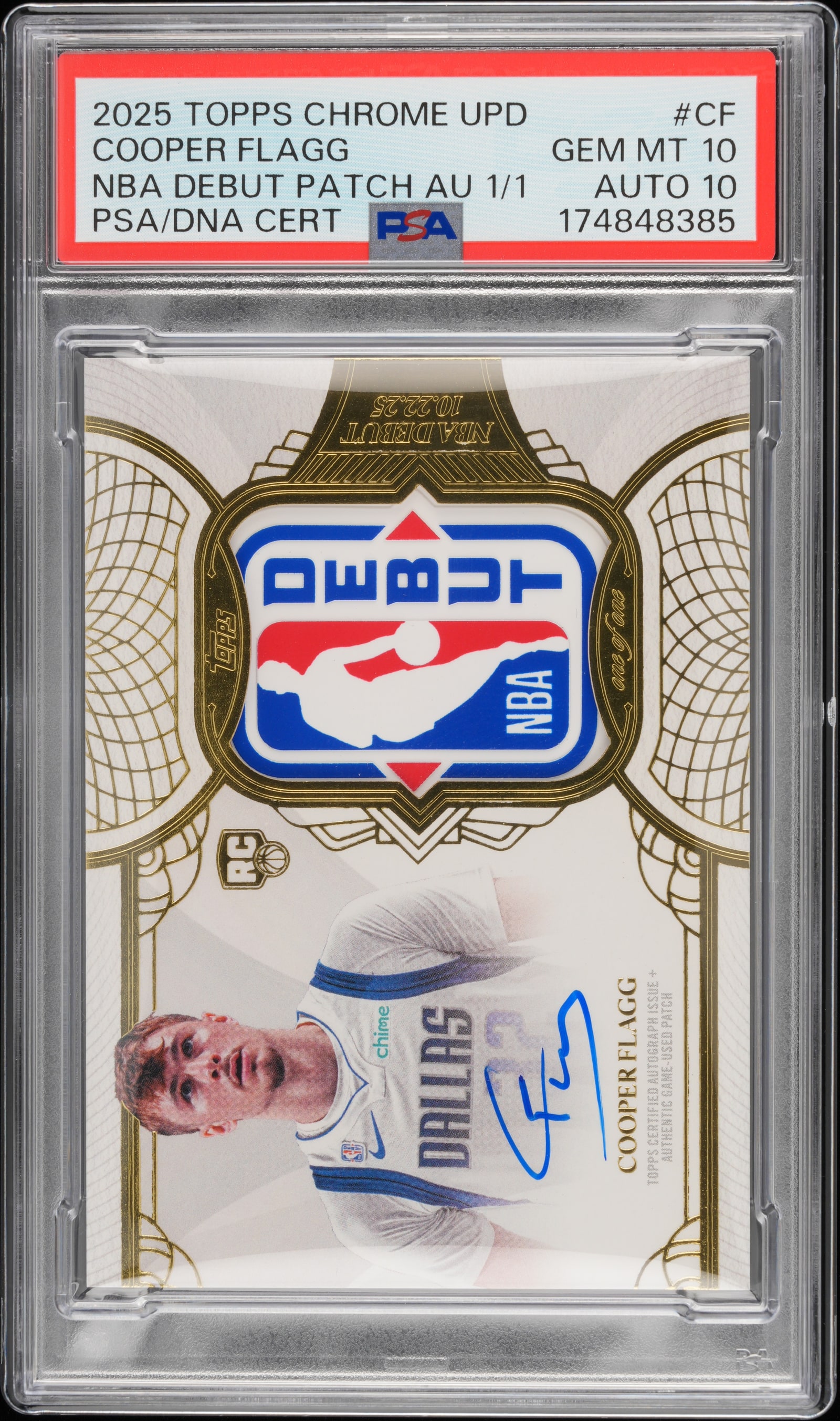
Cooper Flagg 2025-26 Topps Chrome Updates NBA Rookie Debut Patch Autograph one-of-one with a game-used patch from his first NBA game

Last verified: August 11, 2026

Cooper Flagg Debut Patch: the quick facts

DetailVerified status
Card2025-26 Topps Chrome Updates Basketball Rookie Debut Patch Autograph 1/1
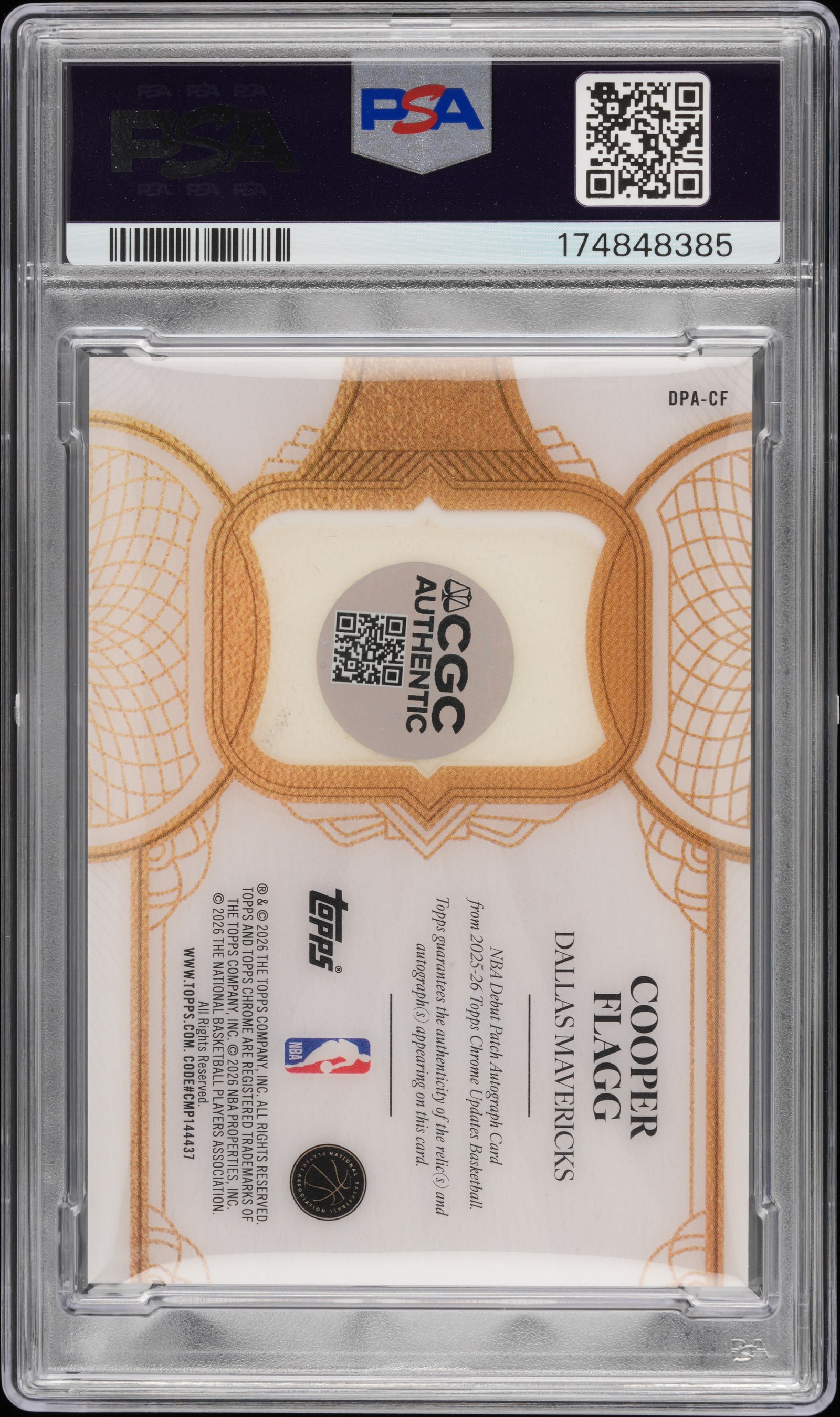
Checklist codeDPA-CF
Player/teamCooper Flagg, Dallas Mavericks
PatchThe first NBA Debut patch Flagg wore on October 22, 2025
AutographSigned and publicly unveiled by Flagg at Fanatics Fest on July 17, 2026
PullRhodyBreakers, August 10, 2026, in a three-box Hobby PYT
What came out of the packA redemption card, not the finished physical card
Dallas spot priceReported as $515 by community sources; no archived official listing or receipt located
Latest statusNo public confirmation of redemption delivery, grading, consignment, sale, or accepted bounty as of August 11

Topps describes 2025-26 Topps Chrome Updates as the NBA debut of the Rookie Debut Patch Autograph program. The cards are true one-of-ones pairing an autograph with a game-worn patch from a player's first NBA appearance.

What was pulled - and what was not

RhodyBreakers hit the Flagg redemption during a Monday-night three-box pick-your-team break. The standalone break video reaches the reveal at about 18:34.

The pack did not contain the thick, signed patch card shown in Topps' promotional images. It contained a redemption. Flagg had already signed and unveiled the finished physical card at Fanatics Fest in July, so fulfillment requires the owner to submit the redemption and receive the card from Topps.

That detail does not erase the hit, but it creates a few open collector questions:

  • Has the redemption been submitted?
  • When will Topps deliver the physical card?
  • What will its corners, surface, autograph, and overall eye appeal look like in hand?
  • Will the owner grade it, authenticate it, consign it, sell privately, or hold it?

None of those steps had been publicly confirmed by the last-verified time above.

RhodyBreakers reveals the Cooper Flagg Rookie Debut Patch Autograph redemption at about 18:34 of its three-box break on Aug. 10.

Why this one-of-one is different

The value case is not simply that Topps labeled the card a one-of-one.

Flagg wore three separate removable NBA Debut patches during his October 22, 2025 debut against San Antonio. Topps confirmed it would use the first patch Flagg wore for the card and destroyed the other two game-worn patches, leaving the selected first patch as the only surviving one of the three NBA Debut patches Flagg wore that night. The jerseys themselves were not destroyed.

The card therefore combines four attributes that do not normally appear together:

  1. A documented piece from Flagg's first NBA game.
  2. The only surviving one of the three purpose-made NBA Debut patches he wore that night.
  3. Flagg's on-card autograph.
  4. The inaugural NBA release of a format that already produced a seven-figure baseball sale.

The fourth point deserves more weight than a normal "first-year" label. This is the first licensed NBA Rookie Debut Patch class, created as Topps returned as the league's exclusive trading-card licensee. Future stars can have future Debut Patch cards, but there can be only one inaugural NBA class. Flagg is its defining chase. If the format becomes a permanent part of basketball-card collecting, this card will always be the first class's flagship rather than one more annual one-of-one.

That does not make every inaugural card a grail. It matters here because the designation is attached to the most valuable rookie in the class, a documented first-game artifact, the only surviving one of the three NBA Debut patches he wore that night, and an on-card autograph. The historical claim belongs to the object, not merely to Topps' marketing copy.

There is also a collector distinction worth making carefully: this is a purpose-made commemorative patch that Flagg actually wore in his NBA debut. It is game-used and tied to a precisely documented event; it is not a generic manufactured relic. Unlike a traditional team Logoman cut from a standard uniform, however, the patch was created for this program, and its scarcity was deliberately reinforced when Topps destroyed the two additional game-worn patches. Its strength is event provenance rather than organic vintage scarcity.

The first-half jersey from that same debut sold privately through Sotheby's for $1 million. A jersey and a card are different markets, and the private transaction has no public bid ladder, but the result confirms serious demand for Flagg's first-game provenance before the card-market packaging and autograph are added.

Before valuing it, define the evidence

The hobby often compresses very different numbers into one word: “value.” A collector should separate them first.

BCI's basketball card value guide starts with comparable sales and then adjusts for rarity, player demand, product hierarchy, condition, and provenance. A card with no exact comp requires the same discipline, with wider confidence bands.

Evidence typeWhat it tells usWeight in this valuation
Realized public saleA buyer paid a disclosed price after market exposureHighest
Reported private saleA transaction reportedly closed, but bidding and fees are usually privateHigh, with a disclosure discount
Written, unconditional cash offerCan establish a practical reservation price while validHigh only after funding and terms are verified
In-kind bountyShows promotional demand, but utility and cash value vary by ownerModerate to low
Auction advance or guaranteeFinancing or downside protection attached to a consignmentNot a sale; analyze the contract
Asking price, forecast, or social claimShows sentiment and marketing ambitionLow

This is why the largest number on Instagram is not automatically the best comp.

The publicly advertised bounties and proposals

The table below ranks the visible dollar amounts, not their legal enforceability. “Publicly posted” means the post can be traced; it does not mean BCI has reviewed a contract, proof of funds, or escrow instructions.

Advertised amountWho posted itStructureWhat collectors should know
$4.0M@sheripscards, posted for @jellybeanxooAdvertised direct-purchase bountyHighest public number located. No public contract, proof of funds, escrow, expiration, or settlement mechanics were found. Source
$3.5MChad Bleznick / BlezAdvertised direct-purchase bountyThe original public post said $1.5M; a later co-post corrected the current amount to $3.5M. Detailed current terms remain private. Source
$3.25MNoir CapitalPublished acquisition proposalThe clearest public structure: $1M cash, $2.25M wire, plus 30% of net auction proceeds above $3.25M. Funding and creditworthiness have not been independently verified. Source
$1.5MGoldinConsignment advanceAn advance if the card is consigned. It would be recouped from future sale proceeds; the remaining economics depend on the consignment contract and fees. It is not a $1.5M purchase. Source
$1.3MAlways LegitAdvertised direct-purchase bountyThe exact card is named, but no public payment mechanics, proof of funds, expiration, or agreement were found. Source
No stated cash valueDallas MavericksTickets and experiencesTwo premium lower-level seats for 32 years plus a signed game-worn Flagg jersey, team and player experiences, and a Boston road trip. Transferability, playoff rights, taxes, arena protections, and expiration are not public. Official post

The Mavericks package may be uniquely valuable to a Dallas superfan. It is also illiquid and difficult to compare with cash. Thirty-two years of tickets sounds enormous, but the present value depends on seat location, annual price inflation, playoff inclusion, transferability, arena changes, tax treatment, and whether the rights survive every season promised.

The $1.5 million Goldin proposal needs a different label entirely. An advance supplies immediate liquidity against a future consignment and is recouped from sale proceeds. The consignor's remaining economics depend on the contract and fees, so the advance should not be added to the eventual sale price or treated as a completed transaction.

One more number should stay outside the bounty table: eBay Live had an official $50,000 cardholder pull bonus plus $5,000 for the breaker on qualifying streams. RhodyBreakers' YouTube break did not qualify, and the unique redemption is now out of packs. That was a platform promotion, not an offer to buy the card.

The realized comps that matter

No exact NBA comparison exists because this is the first licensed NBA Rookie Debut Patch class. The best available approach is to triangulate among Flagg's own market, exact-format baseball sales, Topps' game-worn debut- and award-patch programs, the same debut artifact, and established basketball grails. Public-auction figures below are buyer-facing totals including buyer's premium where the source discloses it; private transactions are labeled separately.

EvidenceReported priceWhy it mattersMain limitation
Flagg Topps Chrome Sapphire Padparadscha rookie auto 1/1, PSA 7$366,000 all-inFlagg's verified public card record and primary player anchorOne exceptional result may not be repeatable
Flagg Bowman Chrome Rose Gold Mojo rookie auto 1/1$240,000 all-inA second recent Flagg trophy-card anchorDifferent product and no NBA debut provenance
Paul Skenes MLB Rookie Debut Patch Auto 1/1$1.11M all-inClosest seven-figure exact-format precedent; 64 bidsCorporate buyer, viral pull and national publicity
Nick Kurtz MLB Rookie Debut Patch Auto 1/1$516,000 all-inRecent completed exact-format sale with 44 bidsBaseball demand and player market differ
Josh Allen Topps MVP Gold NFL Shield Patch Auto 1/1$1.35M all-inGame-worn Topps award-patch auto reset Allen's record; 41 bidsProven MVP; redemption represented a future finished card
Shai Gilgeous-Alexander Topps MVP Gold NBA Logoman Auto 1/1$1.06M all-inSame Topps game-worn award-patch playbook in the NBA; 42 bidsProven MVP; unredeemed redemption rather than finished card
Shohei Ohtani Topps MVP Gold MLB Logoman Patch Auto 1/1$3.0M all-inProves a Topps game-worn award-patch auto can reach this rangeOhtani is a global, established superstar
Flagg first-half NBA debut jersey$1.0M privateSame player and same documented debutDifferent asset class; private mechanics undisclosed
Luka Doncic National Treasures Logoman RPA 1/1$3.12M publicEstablished basketball trophy-card guardrailEntrenched RPA hierarchy and a more proven career
Victor Wembanyama Prizm Black rookie 1/1, PSA 10$5.11M privateModern basketball stretch guardrailPrivate mechanics and a different card hierarchy
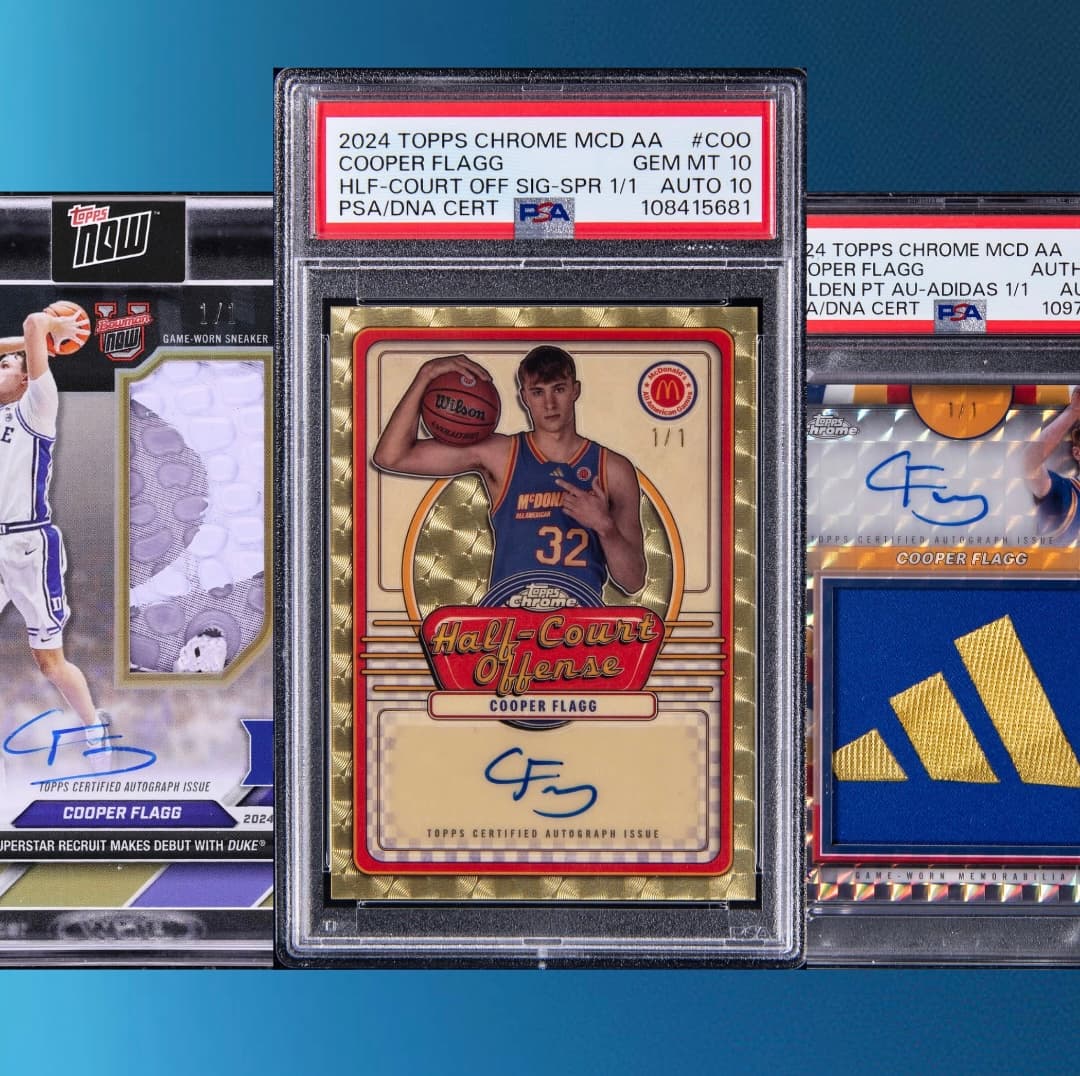
Cooper Flagg 2025-26 Topps Chrome Sapphire Padparadscha rookie autograph one-of-one graded PSA 7
Flagg's current verified public card record is $366,000 for this Topps Chrome Sapphire Padparadscha rookie autograph 1/1, PSA 7. It is the same-player starting point—not a direct substitute for the game-used Debut Patch Auto.

Why Topps' performance-patch sales strengthen the Flagg case

The shared signal across Skenes, Allen, Shai and Ohtani is not merely that each card reached seven figures. Collectors were willing to elevate a Topps card when its game-used patch carried specific, easily understood debut or award provenance rather than supplying generic memorabilia.

Skenes is the closest structural precedent: his $1.11M Rookie Debut Patch Auto preserved a piece of his first major-league game and became his defining rookie artifact. Allen's $1.35M MVP Gold Shield Auto and Shai's $1.06M MVP Gold Logoman Auto show that the same provenance-first logic also works for achievement patches. Shai's buyer-facing result — an $870,000 hammer plus 22% buyer's premium — was 84% above the $577,306 result for his physical 2019-20 Flawless Logoman Autograph 1/1 less than three months earlier. In each case, collectors treated the documented game-used patch as capable of creating a new player grail, even when the auction item was still a redemption.

Flagg brings a different combination of strengths. His card preserves the first patch worn in his first NBA regular-season game, carries his on-card autograph, contains the only surviving one of the three NBA Debut patches he wore that night, and leads the inaugural NBA Rookie Debut Patch class. Allen and Shai arrived with completed MVP résumés; Flagg arrives with rookie-card status and a place in the history of a new NBA program. His future career creates a wider range of outcomes, but that open-ended future is also part of what distinguishes a foundational rookie artifact from a retrospective achievement card.

Ohtani's $3M Gold Logoman demonstrates that the Topps performance-patch platform can reach this price tier when player demand, provenance and presentation align. It does not set Flagg's price by itself. Combined with Flagg's $366,000 card record, the reported $1M sale of his debut jersey and the inaugural-NBA significance of this card, it makes a $3M-$4M auction outcome credible without making it automatic.

Flagg's current sales ladder is maintained on BCI's verified Cooper Flagg card sales board. The broader context belongs in the Cooper Flagg rookie-card hierarchy, while the exact set construction belongs in the 2025-26 Topps Chrome Updates NBA Debut Patch Autographs guide.

The Luka and Wembanyama results place the proposed range inside the established modern basketball trophy market. BCI's largest verified basketball-card sales provide that wider context without requiring either card to function as a direct comparison.

Cross-sport comparison of realized game-used patch autograph sales for Paul Skenes, Josh Allen, Shai Gilgeous-Alexander and Shohei Ohtani beside BCI's $3 million to $4 million Cooper Flagg estimate with no midpoint
All four comparison patches were worn in games. The blue bars are realized buyer-facing auction totals; Flagg's orange $3 million-$4 million band is an estimate, not a sale, floor or midpoint.

Why the range is $3 million to $4 million

A clean formula would be comforting and false. Applying the observed Skenes and Kurtz format-premium multiples to Flagg's prior sales produces dramatically different answers depending on which Flagg sale is used as the starting point. That math remains a sensitivity test, but it misses the evidence that makes this card unusual: the first NBA class, the sole surviving patch, the same-debut jersey sale, Topps' broader game-worn debut- and award-patch market, and the advertised market signals around this exact card.

The range is therefore a triangulation, not an average:

Valuation layerEvidenceWhat it contributes
Flagg's established card market$366K record; $240K second-highest saleEstablishes multiple six-figure trophy results before debut provenance is added
The same NBA debutFirst-half jersey sold privately for $1MProvides evidence of seven-figure demand for the underlying moment outside the card market
Exact-format precedentSkenes $1.11M; Kurtz $516KEstablishes what completed MLB Rookie Debut Patch Autos have cleared
Topps game-worn patch validationAllen $1.35M; Shai $1.06M; Ohtani $3MShows that authenticated debut and award patches can become category-defining player cards
Historic designationHeadline card from the first-ever NBA RDPA checklist; first of three Flagg patches preservedSupplies the premium that ordinary Flagg one-of-ones do not have
Advertised market signalsPublic bounties and a structured proposal from $3.25M to $4MSupports the band only after terms and funding are verified; these are not completed sales
Basketball guardrailsLuka $3.12M public; Wembanyama $5.11M reported privatePlaces the range inside the modern basketball trophy market rather than above it

None of those figures should be added together. Collectively, they explain why a normal Flagg one-of-one is the starting point rather than the answer.

At $3 million, a buyer would be paying about 2.7 times the Skenes result and 8.2 times Flagg's existing card record. At $4 million, those multiples become 3.6 times and 10.9 times. The premium is not justified by one rookie season alone. It is a bet that the headline card from the first NBA Rookie Debut Patch class remains a permanent piece of basketball-card history.

Flagg has already reduced some of the original prospect risk: he won Rookie of the Year after averaging 21.0 points, 6.7 rebounds, 4.5 assists and 1.2 steals, and became the first rookie since Michael Jordan to lead his team in total points, rebounds, assists and steals. That strengthens the range; it does not remove long-term career risk.

Would BCI invest at $3 million to $4 million?

No. We can believe this card will sell in the range and still choose not to own it there.

Historic and investable are not synonyms. At $3 million-$4 million, the buyer is concentrating an extraordinary amount of capital in one young player, one newly introduced basketball format and a future resale market that may contain only a handful of qualified bidders. Flagg's career outcome, the physical card's condition, Topps' long-term basketball hierarchy and the first-sale publicity premium are all still unresolved.

Recent sales show the opportunity cost of that capital:

Established basketball grailRealized priceWhy BCI prefers the risk profile
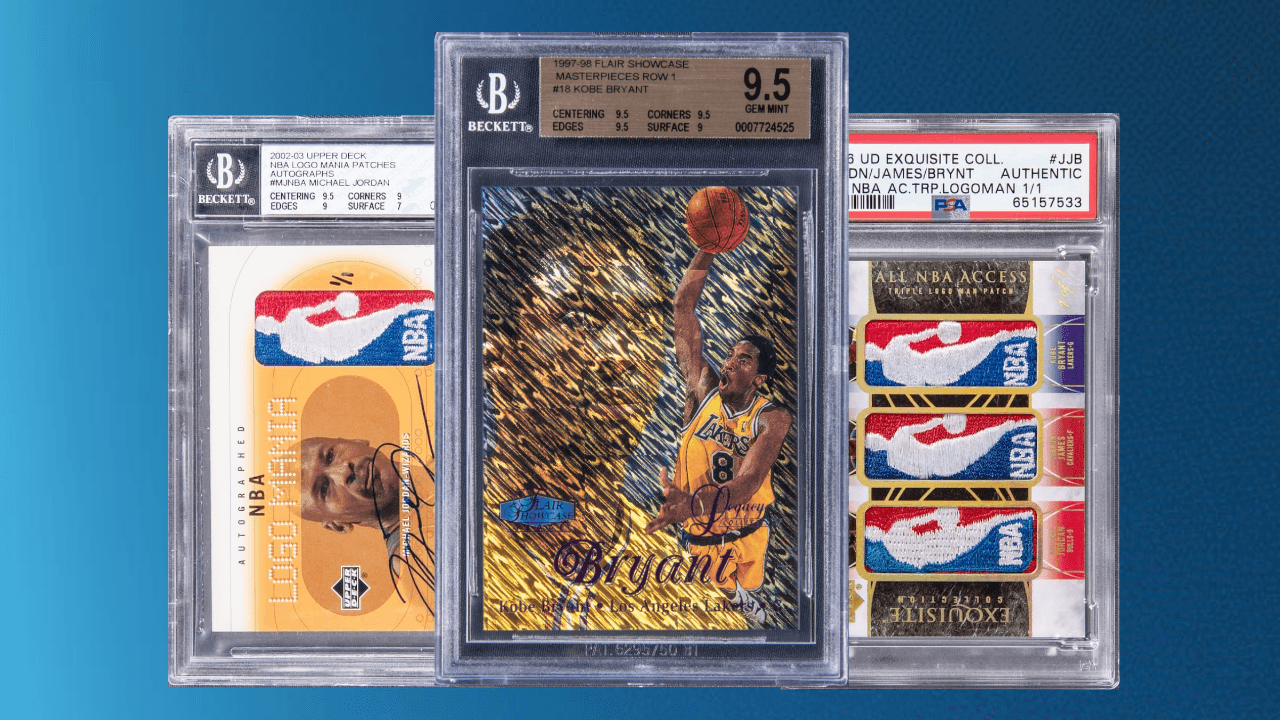
2003-04 Upper Deck Ultimate Collection Michael Jordan Logoman Auto 1/1$2.928M publicA game-used, signed one-of-one featuring the hobby's most established athlete
2003-04 Upper Deck Exquisite LeBron James RPA /23$2.928M publicA rookie grail in a hierarchy collectors have recognized for more than two decades
2018-19 National Treasures Luka Doncic Logoman RPA 1/1$3.12M publicA defining rookie card of a far more proven player in basketball's established flagship RPA product
1997-98 Metal Universe Kobe Bryant PMG Green #009/100, PSA 5, one of 10 Green copies$3.15M privateAn iconic 1990s scarcity card with a mature Kobe collector base and a far longer market history
1997-98 Upper Deck Game Jersey Auto Michael Jordan$4.25M privateSlightly above the range, but tied to a mature icon, early game-used history and an entrenched collector base

Past sale prices do not mean those exact cards are currently available, or that they will repeat those results. They show what this budget has historically been able to reach. With $3 million-$4 million of collecting capital, we would rather build a portfolio of established Jordan, LeBron and Kobe grails, or pursue one proven all-time card, than place the entire position in one young player's rookie card while his playing legacy and card hierarchy are being priced at the same time.

That is a collector preference, not a claim that the Flagg card is overvalued. The distinction is important: historic card, defensible sale range, not BCI's investment choice.

What the pull means for sealed Topps Chrome Updates

The Flagg DPA-CF redemption can no longer be pulled from another box. That removes the product's single most publicized chase, but it does not empty the checklist.

Topps' checklist also includes Rookie Debut Patch Autos for Kon Knueppel and Dylan Harper, but BCI had not independently verified their current pull status as of August 11. The product also contains SuperFractors, autograph one-of-ones, and short prints. Collectors evaluating sealed wax should recheck which major cards remain live, then separate their probability-adjusted value from the product's original launch narrative.

For collectors, a live “what is still in packs?” tracker is more useful than a static checklist once major hits begin surfacing. BCI's Topps Chrome Updates guide is the natural home for that status data.

Collector verdict

On the evidence available August 11, a properly marketed public-auction range of $3 million to $4 million, including buyer's premium, is defensible. We are not publishing a midpoint. The result will depend on whether at least two serious buyers treat the inaugural-NBA designation as permanent hobby history rather than temporary launch-year excitement.

Calling $4 million a guaranteed floor goes beyond the completed sales record. Calling the card worth only Flagg's prior $366,000 high ignores the first-game provenance, on-card autograph, the only surviving one of the three debut patches he wore that night, the $1 million debut-jersey sale and the way Skenes, Allen, Shai and Ohtani performance-patch cards have traded under Topps.

This is very likely Flagg's defining card and the headline artifact of the first NBA Rookie Debut Patch class. BCI would still rather invest the same capital in established Jordan, LeBron, Kobe and proven grail categories. Those judgments are not contradictory: historic card, $3 million-$4 million sale range, not BCI's investment choice at that price.

Next best stepCooper Flagg collector

Keep building the Cooper Flagg market picture

Continue with Flagg's verified sales ladder, his broader rookie-card hierarchy, and the exact Topps Chrome Updates NBA Debut Patch Autographs guide.

BCI Dispatch

Make the next card decision with better context.

Get collector-first guides, rankings updates, verified sales, and the market context that matters before you buy.

Your email is used to send the BCI Dispatch. Privacy & data handling

Have a player, set, card, or budget question instead? Open the Collector Mailbag.

Continue reading
Related stories