
Legacy
25%8.6
This is the permanent all-era pull of the player. It rewards names the hobby will keep circling back to even after short-term market cycles cool off.
Knicks championship icon | Value
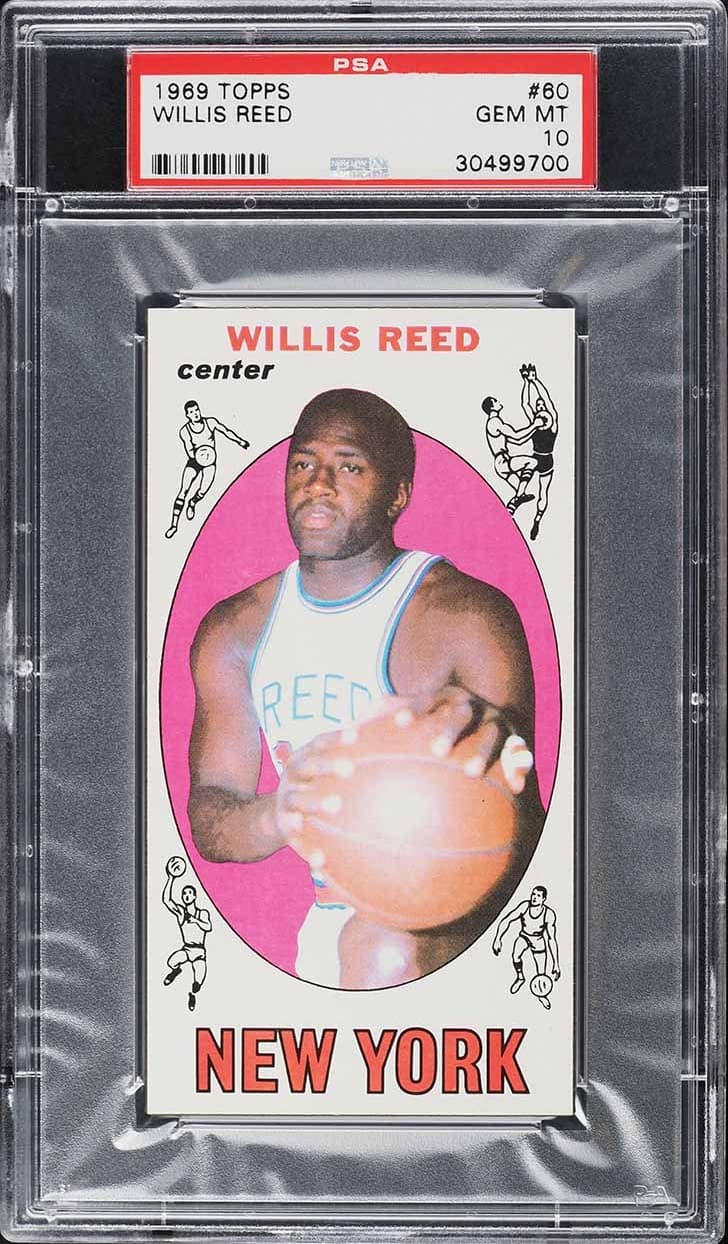
1969 Topps tall-boy rookie with a rare 1968 Test first-card tier
Reed owns one of basketball's most replayed championship moments and a New York collector base, but the card hierarchy is compact. The 1969 Topps rookie is the liquid lane; the 1968 Test is the advanced, provenance-sensitive trophy.
BCI collector score
8.1
Value
Best buy lanes
Start with 1969-70 Topps Willis Reed rookie in PSA 4-6. It gives Willis Reed collectors a recognizable reference point without paying for scarcity before the copy earns it.
What makes sense
Buying caution
Do not buy scattered low-end volume just because the player name is historically important.
1969-70 Topps Willis Reed rookie in centered PSA 7 is the market spine. Favor clean, accurately graded copies and compare eye appeal before stretching into a thinner lane.
What makes sense
Buying caution
If the card sits outside the real hierarchy, the discount has to be obvious.
1969-70 Topps Willis Reed rookie in PSA 8 is the premium step because the card adds a real product, condition, or scarcity upgrade instead of a louder label.
What makes sense
Buying caution
At this range, product strength and copy quality matter more than owning one more famous name.
At grail money, 1969-70 Topps Willis Reed rookie in PSA 9 needs strong eye appeal, an explainable population story, and patient price discovery.
What makes sense
Buying caution
Do not pay grail money unless the card itself has grail-level demand, scarcity, or historical weight.
Trophy-level spend belongs in 1968 Topps Test Willis Reed #7 with strong provenance. If that exact tier is unavailable, wait instead of substituting a merely expensive card.
What makes sense
Buying caution
Trophy-level buying should be patient, card-first, and honest about the buyer pool.
The 1970 Finals story can make every Reed card feel iconic; collectors should reserve that premium for his first two Topps issues.
Score breakdown
Legacy
25%8.6
Catalog
22%7.5
Proof
18%7.8
Closed
17%9.0
Liquidity
10%6.9
Price
8%7.9
Sales proof
Core lane
This is the cleanest card-market reference point for the profile and the first lane collectors should understand.
Scarcity lane
Scarcity only helps when the product family and player demand are strong enough to make the card easy to explain.
Keep going