Showtime pillar
Magic Johnson Card Profile
BCI Collector Score
8.4/10
Blue Chip
Score breakdown
Scores /10 · Weights %
- Basketball achievements and the player's lasting appeal to collectors.25% weight
- 9.4
- The strength of the player's defining rookies, inserts, autographs and patch cards.20% weight
- 8.3
- How consistently collectors buy the player's important cards, supported by repeat sales.20% weight
- 8.2
- How well key cards stand apart as new releases and more parallels add supply. Higher means less risk of dilution.15% weight
- 8.1
- How easy it is to find comparable sales and buyers across different budgets.10% weight
- 8.4
- How much room today's prices leave for the player's long-term case to improve. Higher means less future success is already priced in.10% weight
- 7.0
Shared rookie icon with selective autograph and vintage lanes
Magic's card market is not as structurally deep as Jordan, Kobe, or LeBron, but the hobby gravity is heavier than a lot of modern markets with bigger checklists. The 1980 Topps Bird/Erving/Magic card is iconic, and the Showtime legacy gives his best cards a historical weight Luka and AI have not fully matched.
Buy lanes
Cards to consider
A card to consider at each budget. Grade, condition and the individual copy affect what you pay.
Entry Lane$500 and below1986-87 Fleer Sticker Magic Johnson #7
1986-87 Fleer Sticker Magic Johnson #7
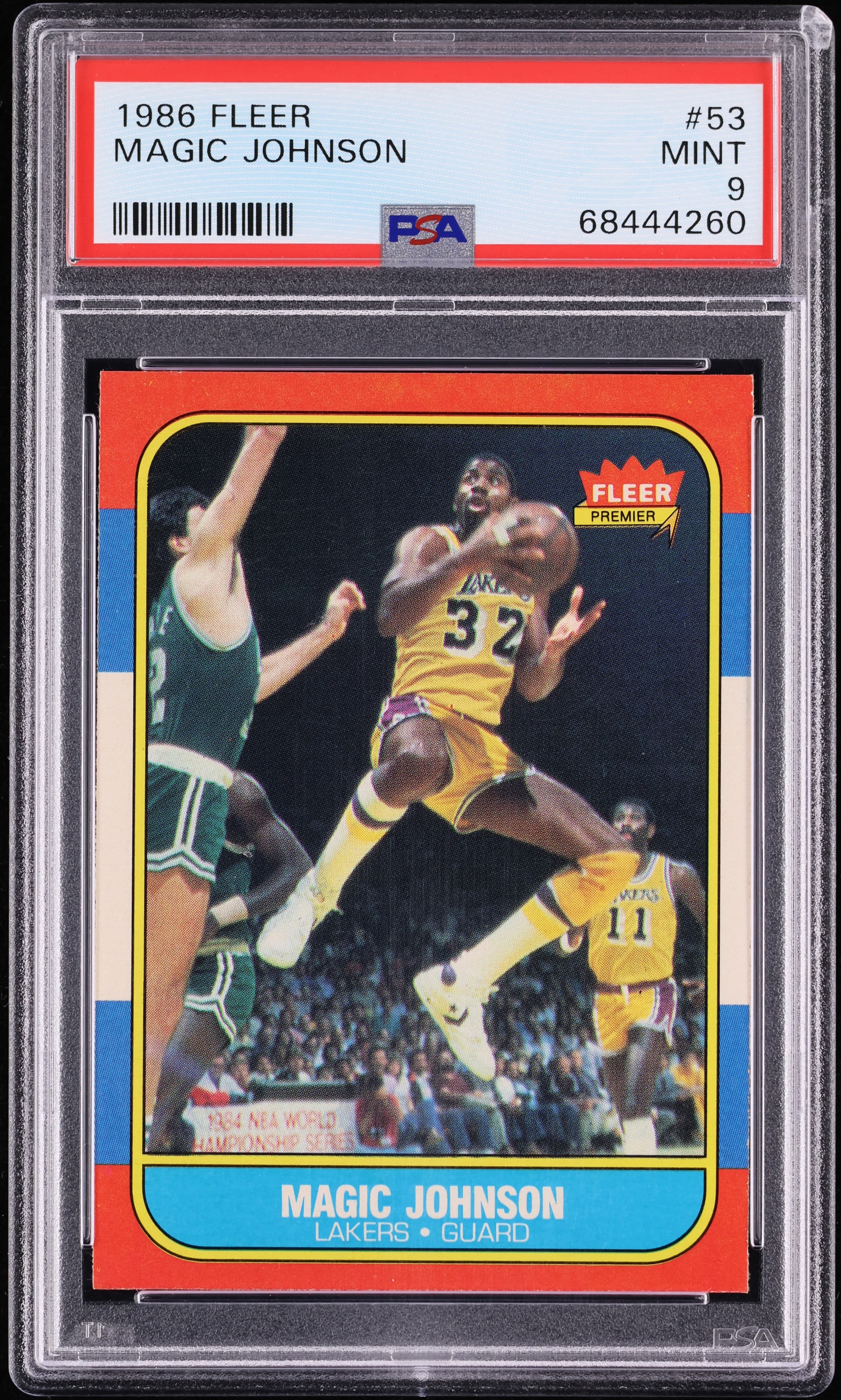
Reference image—shown card: 1986-87 Fleer Magic Johnson #53
Evaluate 1986-87 Fleer Sticker Magic Johnson #7 as the specific Entry Lane card for Magic Johnson. Compare only like-for-like sales and keep grade secondary to the importance of the issue itself.
Buying caution
Do not buy separated 1980 Topps panels, rough raw panels, or modern tribute autos just to say you own something rookie-year related. In this band, clean solo vintage is the smarter Magic buy.
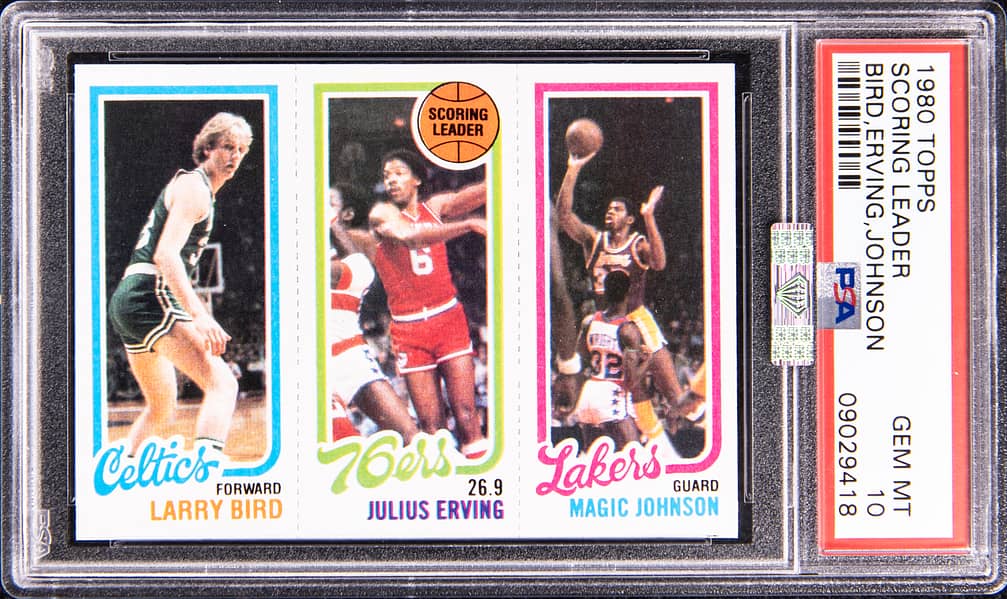
Core Lane$500 to $2,5001980-81 Topps Bird / Erving / Magic Scoring Leader rookie
1980-81 Topps Bird / Erving / Magic Scoring Leader rookie
Reference image—shown card: 1980-81 Topps Larry Bird Magic Johnson Julius Erving Rookie
Use 1980-81 Topps Bird / Erving / Magic Scoring Leader rookie for Magic Johnson's Core Lane. Confirm the exact issue and copy quality, then compare repeatable sales before committing capital.
Buying caution
This card is notorious for centering, black print defects, and perforation issues. A technically higher grade with a bad front can be a worse Magic buy than a lower grade with real presence.
Premium Lane$2,500 to $10,0002004-05 Exquisite Collection Limited Logos Magic Johnson #LL-MA /50
2004-05 Exquisite Collection Limited Logos Magic Johnson #LL-MA /50
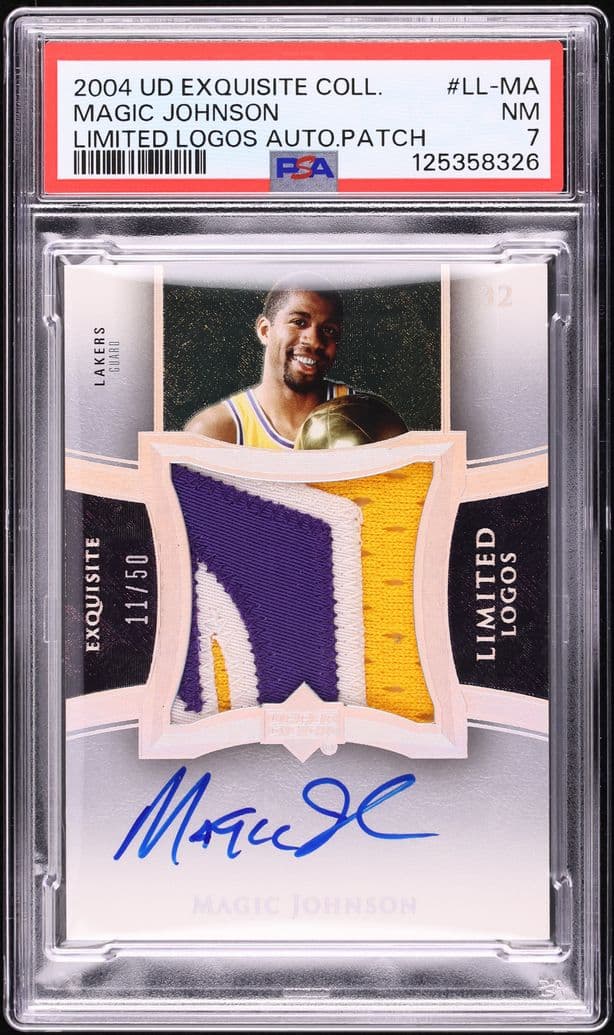
Reference image—shown card: 2004-05 Upper Deck Exquisite Collection Limited Logos Autograph Patch Magic Johnson #LL-MA /50
The card to evaluate for Magic Johnson's Premium Lane is 2004-05 Exquisite Collection Limited Logos Magic Johnson #LL-MA /50. Keep the decision tied to exact-card demand, condition, provenance, and price discipline.
Buying caution
Magic signed a lot. Do not pay premium money for sticker autos, Leaf/unauthorized cards, weak Panini autos, or flat single-color relics when Exquisite and Upper Deck on-card lanes exist.
Grail Lane$10,000 to $50,000Triple-signed 1980-81 Topps Bird / Erving / Magic rookie
Triple-signed 1980-81 Topps Bird / Erving / Magic rookie
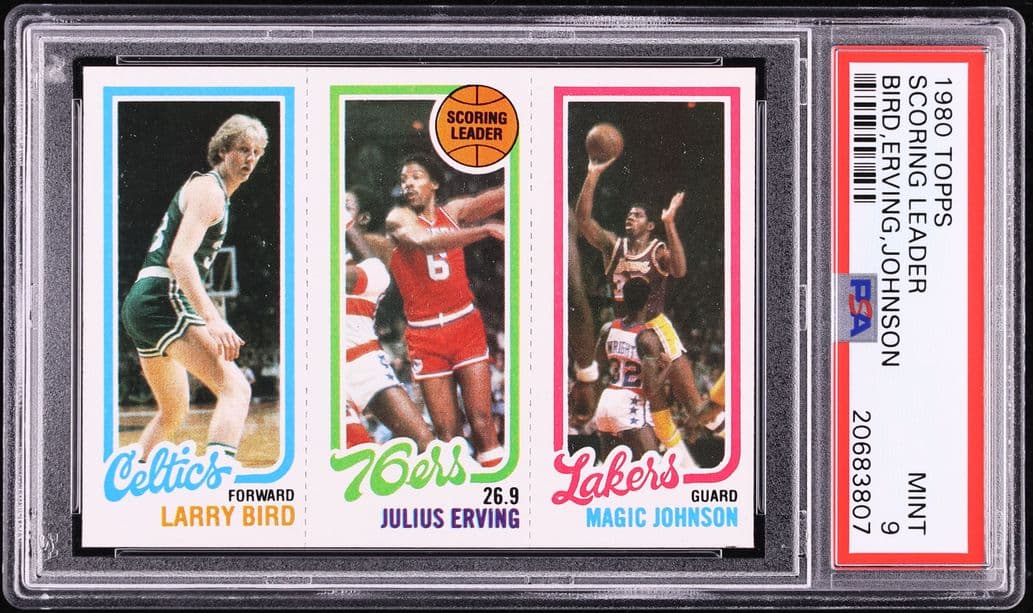
Reference image—shown card: 1980-81 Topps Larry Bird / Julius Erving / Magic Johnson Scoring Leader PSA 9
The card to evaluate for Magic Johnson's Grail Lane is Triple-signed 1980-81 Topps Bird / Erving / Magic rookie. Keep the decision tied to exact-card demand, condition, provenance, and price discipline.
Buying caution
Do not pay grail money for ordinary Magic autographs or overgraded vintage. Above five figures, the card has to be one of Magic's actual answers, not just a scarce card with his signature.
Trophy Lane$50,000+No buy recommended
No buy recommended
No Trophy purchase is recommended for Magic Johnson from the currently supported card ladder. Hold cash until an exact target has defensible scarcity, provenance, and enough buyer depth.
Buying caution
Do not treat every expensive Magic auto as a trophy. Trophy status needs a permanent card identity: the rookie card, a full Bird/Erving/Magic signature story, or top-tier Exquisite construction.
Keep going
Related tools and coverage
Magic Johnson sales
Compare completed sales for this player's cards.
Magic Johnson articles and analysis
Read recent sales coverage and card research.
Open all-time set rankings
Use the all-time set board to place Magic's 1980 Topps rookie-year lane in broader vintage context.
Open all-time sales board
Compare Magic's vintage-card ceiling against the higher-end modern and Jordan/Kobe/LeBron grail markets.