
1980s assist king
John Stockton Card Profile
BCI Collector Score
7.2/10
Selective Buy
Score breakdown
Scores /10 · Weights %
- Basketball achievements and the player's lasting appeal to collectors.25% weight
- 8.0
- The strength of the player's defining rookies, inserts, autographs and patch cards.20% weight
- 6.8
- How consistently collectors buy the player's important cards, supported by repeat sales.20% weight
- 6.2
- How well key cards stand apart as new releases and more parallels add supply. Higher means less risk of dilution.15% weight
- 7.8
- How easy it is to find comparable sales and buyers across different budgets.10% weight
- 6.8
- How much room today's prices leave for the player's long-term case to improve. Higher means less future success is already priced in.10% weight
- 7.3
1988 Fleer rookie with steady but narrow demand
Stockton is respected more than he is chased. The rookie is affordable relative to the resume, but the market is narrow and does not have many natural premium lanes.
Buy lanes
Cards to consider
A card to consider at each budget. Grade, condition and the individual copy affect what you pay.
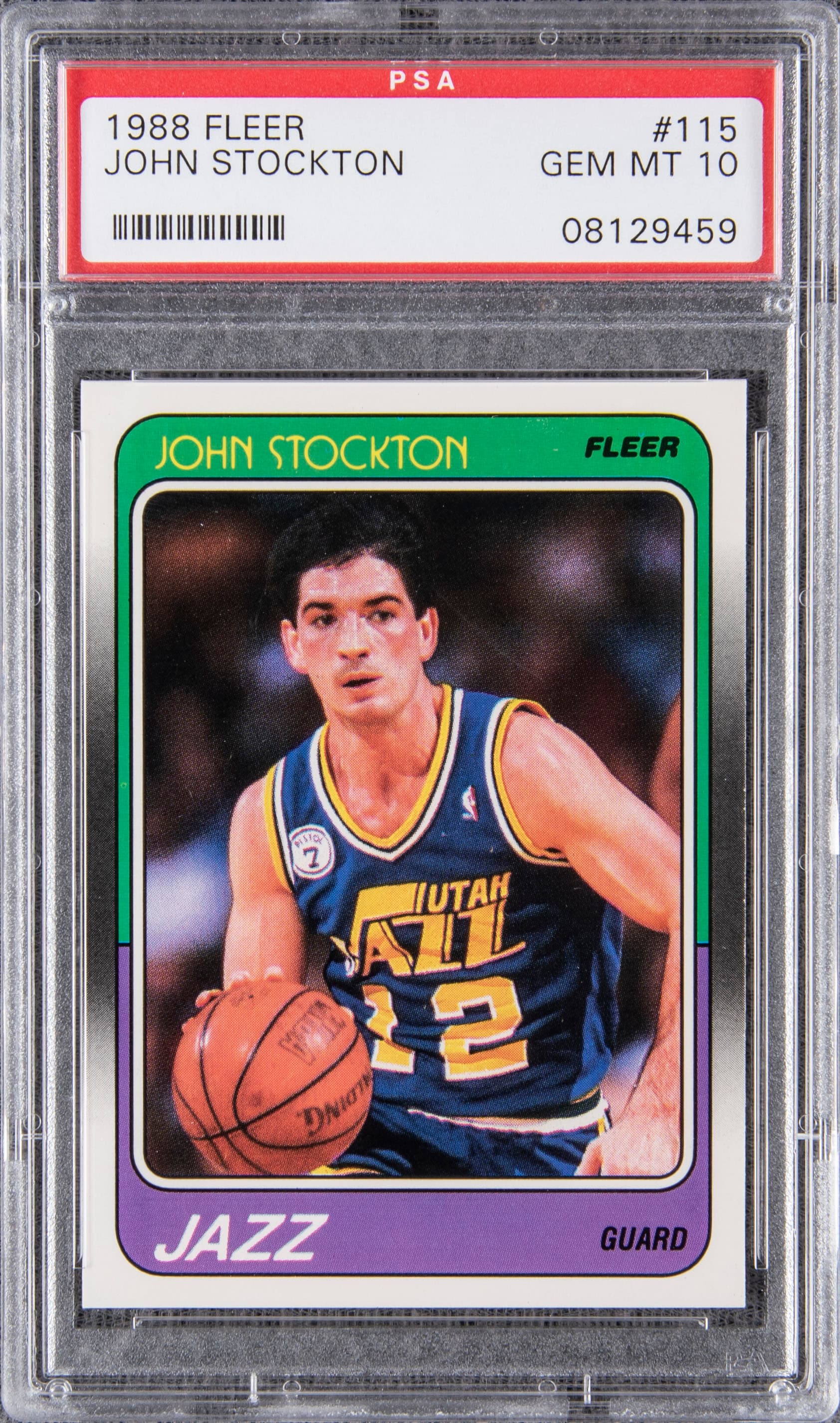
Entry Lane$500 and below1988-89 Fleer John Stockton Rookie #115
1988-89 Fleer John Stockton Rookie #115
Shown copy: 1988-89 Fleer John Stockton Rookie #115
1988-89 Fleer John Stockton Rookie #115 defines the current Entry Lane for John Stockton. Inspect the precise issue and copy, then demand sale evidence appropriate to that card's buyer pool.
Buying caution
Do not buy random post-playing-era inserts as a substitute for the real Fleer rookie lane.
Core Lane$500 to $2,500No buy recommended
No buy recommended
Skip the Core Lane for John Stockton; no buy is recommended under the evidence now available. Revisit it only when one exact, distinct card can justify the budget without relying on grade scarcity.
Buying caution
Do not overpay for a grade bump when the centering or front presentation looks worse than the cheaper copy.
Premium Lane$2,500 to $10,000No buy recommended
No buy recommended
Skip the Premium Lane for John Stockton; no buy is recommended under the evidence now available. Revisit it only when one exact, distinct card can justify the budget without relying on grade scarcity.
Buying caution
The mistake here is paying premium prices for a card whose demand is mostly nostalgia rather than true hierarchy.
Grail Lane$10,000 to $50,000No buy recommended
No buy recommended
John Stockton collectors should record no buy in the Grail Lane for now. A future candidate must be a separate exact card with credible scarcity and market support.
Buying caution
Do not let a thin comp set force the buy. With 1980s Fleer, patience is often the edge.
Trophy Lane$50,000+1997-98 Metal Universe Precious Metal Gems Green John Stockton /10
1997-98 Metal Universe Precious Metal Gems Green John Stockton /10
Reference image—shown card: 1988-89 Fleer John Stockton Rookie #115
For John Stockton, 1997-98 Metal Universe Precious Metal Gems Green John Stockton /10 is the attainable Trophy target. Require strong eye appeal, provenance, and enough repeat-buyer depth to defend the commitment.
Buying caution
Do not pay trophy money for a copy that is scarce only because of the holder. The card itself has to look trophy-level.
Keep going
Related tools and coverage
John Stockton sales
Compare completed sales for this player's cards.
John Stockton articles and analysis
Read recent sales coverage and card research.
Open set rankings
Use the manufacturer boards to place John Stockton's best cards inside the right product hierarchy.
Open Best Rookie Lane by Player
Use the rookie-lane brief to check whether the John Stockton card—not only the player name—is carrying the buy.